

How To Lower Ping Router Settings
Have yous always tried to jump on a video call, only to endure from a inclement connection because your spouse was streaming 4K videos at the aforementioned time? Or maybe you've had a gaming session ruined by your brother who wouldn't suspension his torrent downloads?
If so, you've probably wished in that location was a style to configure your router so that you had a smoother experience. The skillful news is that there is: it's called Quality of Service. Let's see how to set up up QoS for gaming and what benefits it offers.
What Is Quality of Service?
Quality of Service (QoS) is a mechanism on routers that allows you to prioritize the network traffic you see as almost of import. Using information technology, you can make sure that your available bandwidth is used for the almost disquisitional applications instead of being wasted on activities that aren't fourth dimension-sensitive.
Recall of your network every bit a busy highway between your devices and the internet. Quality of Service is similar to dividing that highway into transit, carpool, and emergency service lanes. Merely certain types of traffic are allowed in certain lanes, and some lanes will get to where they're going with fewer delays.

Of grade, the highway still has a maximum number of lanes in each management, and making 1 of them a carpool lane won't increment the amount of total traffic the highway can handle. Information technology just makes it easier for some of the traffic to move more than smoothly.
Also, QoS won't make your internet connectedness faster and it won't expand your total bandwidth throughput. It'southward meant to brand sure that certain apps and services have enough room to move when the network is congested.
Video calling tools like Zoom, as well equally online gaming platforms, are services that are sensitive to either latency or bandwidth. This means they tin do good from QoS settings.
Agreement Latency and Bandwidth
Latency, oftentimes measured every bit "ping," is a measurement of the delay in communication betwixt yous and the device you're talking with over a network. Yous may take had telephone calls where you've noticed a major delay between you saying something and the other person hearing it. This is an example of high latency.
Bandwidth, meanwhile, is the maximum rate at which you lot can download or upload data. This is limited by the speed of your home internet connectedness. Recollect of it like the size of a pipe—the larger the diameter, the more water can catamenia through information technology at once.
Between latency and bandwidth, applications volition by and large exist more sensitive to one or the other.
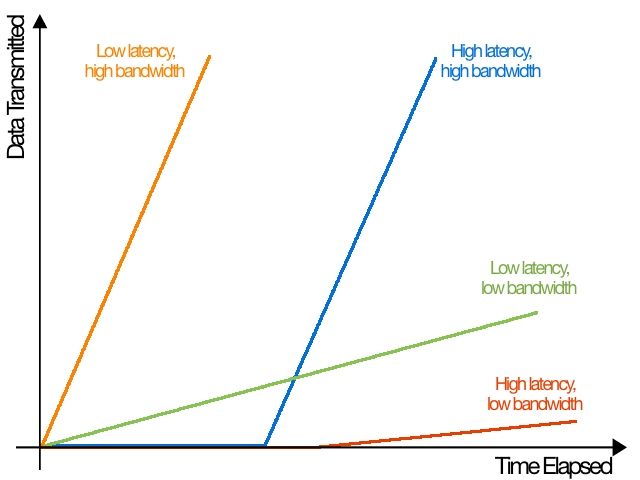
Gaming is extremely latency-sensitive but generally not bandwidth-sensitive. You lot've surely noticed this if you've ever tried playing a game with high latency (oftentimes chosen "lag"). This happens when playing on a server in another continent, for example. Your actions will take a long fourth dimension to manifest in the game, or elements may bound all over the identify while the game tries to catch upwardly and compensate.
Video streaming is very bandwidth-sensitive but not that latency-sensitive. Each video source has a bitrate, which is the amount of data that information technology transfers per catamenia of time, typically measured in bits per second. The higher the resolution of video, the greater its bitrate. If the bandwidth available is less than the required bitrate, the video will stop and have to buffer when information technology runs out of loaded data.
These are the sorts of services that are given tiptop priority by Quality of Service mechanisms, every bit they're the nigh frustrating if they don't run smoothly. You'll ordinarily give lower priority to traffic similar BitTorrent downloads, which isn't often urgent. Activities similar web browsing tend to fall somewhere in the middle.
How Quality of Service Works
Considering services are often disrupted by high latency and depression bandwidth, Quality of Service tin increment performance either by reducing latency or freeing up bandwidth. Each i has its own technique, but the two oftentimes work in tandem to increase overall network performance.
Different kinds of traffic volition benefit from different mechanisms, depending on whether that traffic is latency-sensitive, bandwidth-sensitive, or both.
Queuing (Latency)
Queuing is the master mechanism used to reduce latency for high-priority traffic. A queue allows the router to keep traffic buffered when it's not all the same fix to exist processed.
Quality of Service rules may allow packets (chunks of network data) from high-priority services or applications to leap the queue and get processed first. This helps reduce latency for those important services and applications.
Rate Limiting (Bandwidth)
If as well many packets try to enter the queue at once, the buffer will overflow and packets tin be lost. Charge per unit limiting (also known equally parcel shaping) restricts the number of packets that the queue will accept from a particular source, automatically dropping any extras that the source tries to ship it.
This forces the source to reduce the number of packets that it attempts to transport, effectively limiting the bandwidth afforded to that source. Low-priority traffic sources may be specifically express, whereas a high-priority service may cause all other traffic to get charge per unit limited ("throttled") to free up bandwidth.
Setting Up Quality of Service
The vast majority of Quality of Service mechanisms are handled via your router. Considering it'south the tool that connects your other devices to the internet, it'due south the perfect spot to look at incoming information and sort that information to the unlike devices on the network.
With Wi-Fi, there's a chance you're already using QoS. Some devices and routers support a protocol called Wi-Fi Multimedia (WMM) that automatically sorts information into 4 categories: Voice, Video, Best Effort, and Background (in descending order of priority).
Almost routers have some grade of Quality of Service capability built in, though some are more sophisticated than others. The specific options you have volition depend on your router.
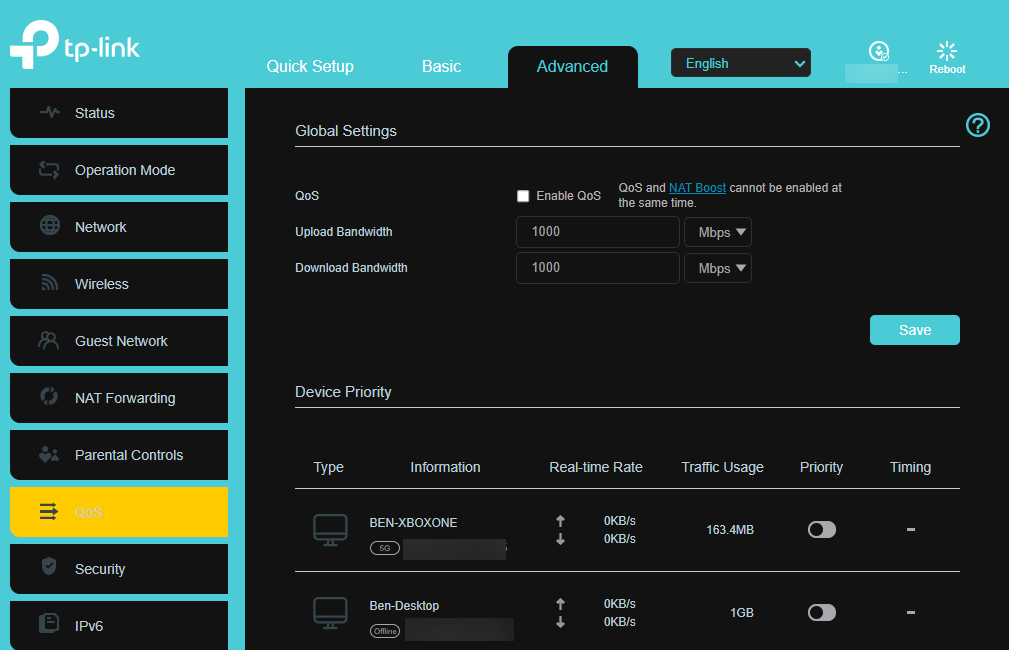
You'll usually find it somewhere in the Advanced department of your router'southward command panel. On our TP-Link router, for example, information technology's nether Avant-garde > QoS. Annotation that other features, such as NAT Boost in our case, must be turned off for QOS to piece of work.
Types of Data Priorities
There are ii primary ways to assign Quality of Service priorities: a per-device ground and a per-awarding basis.
Priority by Device
You may make up one's mind that a item device, such as a gaming console, should be given priority over all others. Every device has a few elements that make it uniquely identifiable on a network: an IP accost, a MAC accost, and a proper name.
Because a device's MAC address is unique and can't be changed, this is by and large the best manner to identify information technology. But if necessary, you lot can use the other elements, depending on your router. Y'all may need to add devices manually, or might be able to merely change settings for a list of devices that your router provides.
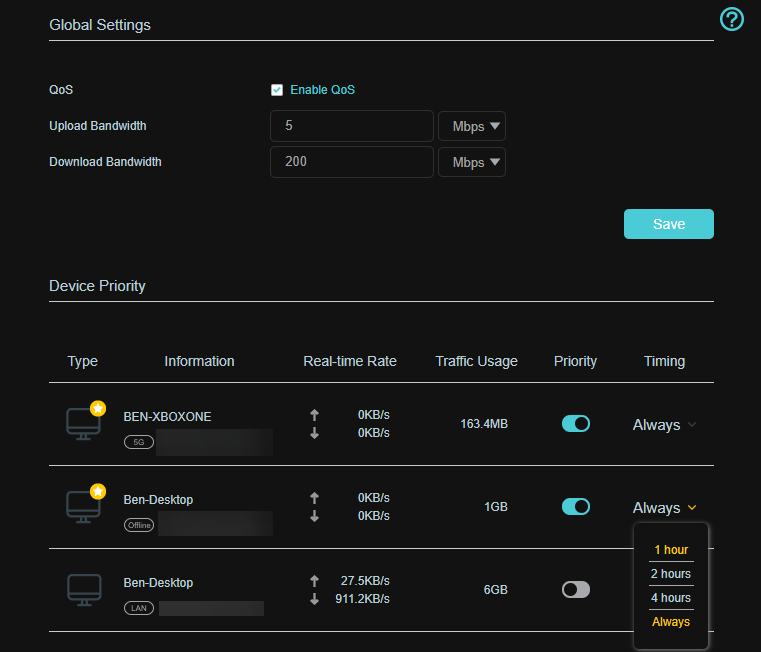
On our TP-Link router, enabling QoS allows you to mark whatsoever device as Priority by enabling a slider. You lot can and then modify the Timing to set how long the device is treated that way. At the top of the page, you should also input your upload and download speeds so the service can work its best.
Priority by Application
Another blazon of QoS assigns priority based on which port or app a slice of data wants to become to. Instead of prioritizing an unabridged device's traffic, it only prioritizes a sure type of information.
For example, if you know that all your BitTorrent traffic goes through port 54321, you lot may set a rule that port 54321 has low priority. Thus, it should only exist given bandwidth subsequently all other apps take gotten the bandwidth they need.
Conversely, yous may set a rule saying that Skype on port 33333 should be given highest priority so its traffic is non just processed first (in order to reduce latency), simply is too given every bit much bandwidth as information technology needs (in order to reduce video choppiness).
Try Quality of Service Yourself
Quality of Service helps latency-sensitive traffic (similar gaming) and bandwidth-sensitive traffic (like video calling) bypass network congestion and allows everything to perform more smoothly, fifty-fifty with a busy network.
You can either configure it on an app-by-app ground or give tiptop priority to a specific device. Your router probably has some form of Quality of Service adequacy built in, then why non give it a try to help your top devices perform when y'all need them virtually?
Image Credit: Profit_Image/Shutterstock
About The Author


How To Lower Ping Router Settings,
Source: https://www.makeuseof.com/tag/fix-gaming-video-lag-easy-router-tweak/
Posted by: jonesthavis.blogspot.com
0 Response to "How To Lower Ping Router Settings"
Post a Comment